

How to Season Meat Like a Chef for Better Flavor
Last Updated: November 2, 2026
Quick Summary
To season meat like a chef, salt by weight rather than by spoon, using 0.75% to 1% of the meat's weight in salt as an everyday target. Apply salt at least 40 minutes ahead so it penetrates, and pat the surface dry before seasoning for even coverage.
- Kosher salt is the chef's default because its coarse flakes are easy to pinch and judge by eye.
- Salt 40 or more minutes ahead so salt penetrates; salting right before cooking seasons only the surface.
- Season from about 8 to 10 inches above the meat so salt and pepper fall in an even rain.
- Give a dry rub at least 40 minutes, or up to 24 hours for larger cuts, kept refrigerated.
- For ground meat, use about 1 teaspoon Diamond Crystal kosher salt per pound and mix lightly.
Table of Contents
- Start With the Right Salt and the Right Amount
- Should You Season Meat Before or After Cooking?
- Pat Meat Dry and Season for Even Coverage
- How Long to Let Meat Sit With Dry Rub
- How to Season Meat for Grilling
- Simple Seasoning for Ground Beef and Mixed Dishes
- Build Flavor With Herbs, Spices, and Oil Blends
- Stock Your Pantry With Chef-Worthy Seasoning Blends
- Frequently Asked Questions
Start With the Right Salt and the Right Amount
Learning how to season meat like a chef starts with one ingredient: salt. Chefs treat salt as a tool, not an afterthought. It pulls moisture to the surface, dissolves, and works its way back in. That process flavors the meat from the inside and helps it hold onto juices.
Get the salt right, and everything else gets easier. Get it wrong, and no spice blend can save the dish.
Kosher Salt vs. Table Salt vs. Finishing Salt
Kosher salt is the chef's default. Its coarse, light flakes are easy to pinch and see, so you can judge coverage by eye. Table salt has fine grains that pack tightly, so a spoonful holds far more salt than the same spoonful of kosher.
The reason this matters is density. A teaspoon of fine table salt weighs roughly 6 grams, a teaspoon of Diamond Crystal kosher salt weighs about 3 grams, and a teaspoon of Morton kosher salt lands near 5 grams. Flaky finishing salts are lighter still, often 2 to 3 grams per teaspoon.
How Much Salt to Use by Weight
The reliable method is to salt by weight, not by spoon, because weight is the only measure that stays constant across salt types.
Here is how that translates into the salts you actually own, per pound of meat:
- Diamond Crystal kosher: about 1 to 1½ teaspoons per pound
- Morton kosher: about ¾ to 1 teaspoon per pound
- Fine table salt: about ½ to ¾ teaspoon per pound
- Flaky sea salt (finishing): about 1½ to 2 teaspoons per pound, but reserve it for after cooking
For bone-in cuts, go lighter since some weight is bone.
- Thin cuts like cutlets: lighter coating, less salt per pound, because the surface-to-mass ratio is high and the salt hits more meat per gram
- Thick cuts like roasts: full coating, more time to absorb
- Ground meat: salt the whole batch at about 1 teaspoon Diamond Crystal kosher salt per pound, mixed in rather than sprinkled on
Weighing beats guessing every time.
Watch out: if you switch brands of kosher salt mid-recipe without rechecking the density, you can swing the salt level by 50% or more in a single dish.
Salt density varies widely by type, so here is how each one measures out per pound of meat.
| Salt type | Grams per teaspoon | Amount per pound of meat |
|---|---|---|
| Diamond Crystal kosher | About 3 grams | About 1 to 1½ teaspoons |
| Morton kosher | Near 5 grams | About ¾ to 1 teaspoon |
| Fine table salt | Roughly 6 grams | About ½ to ¾ teaspoon |
| Flaky sea salt (finishing) | Often 2 to 3 grams | About 1½ to 2 teaspoons, after cooking |
Should You Season Meat Before or After Cooking?
Season meat before cooking for the best flavor and texture. Salt applied ahead of time has a chance to penetrate, while salt added at the end mostly sits on the surface. Timing is the difference between meat that tastes seasoned and meat that tastes salted.
Why Timing Changes Texture and Flavor
Salt draws moisture out, then that moisture dissolves the salt and pulls it back into the meat. This is why salting early works. The USDA food safety guidance on meat preparation recommends keeping raw meat refrigerated during any advance seasoning.
Salting right before cooking is fine when you are short on time, but the salt stays on top. The Wisconsin Beef Council's advice on seasoning beef notes that salting 30 minutes ahead can draw out moisture, so either salt well ahead or right at the pan.
- Salt 40+ minutes ahead: salt penetrates, meat stays juicy
- Salt right before cooking: surface seasoning only
- Salt at the table: crunch and finish, not depth
Pat Meat Dry and Season for Even Coverage
A dry surface is the secret to a good crust. Moisture on the meat has to cook off before browning can start, so wet meat steams instead of searing. Pat the surface with paper towels until it feels tacky, not wet.
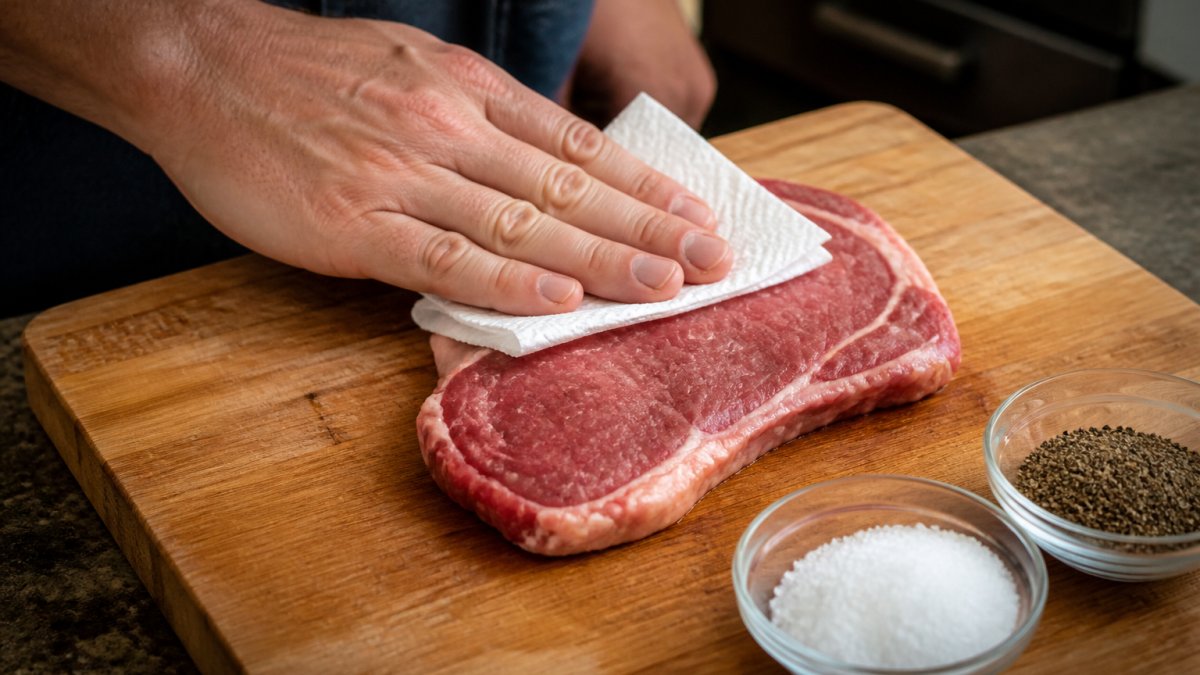
Then season from about 8 to 10 inches above the meat. This height spreads the salt and pepper in an even rain rather than clumps. Use your fingers to press it in gently. Even coverage matters more than a heavy hand, because a patchy crust tastes uneven.
How Long to Let Meat Sit With Dry Rub
Give a dry rub at least 40 minutes, or up to 24 hours for larger cuts. A dry rub is simply a mix of salt, pepper, and spices applied to the surface. Short rests flavor the outside; longer rests let salt and spices work deeper.
Tuscan Cooking & Dipping Oil Infusion Kit →
For steaks and chops, 1 to 4 hours in the fridge is a sweet spot. For a whole chicken or a pork shoulder, overnight gives the best result. Always keep the meat covered and refrigerated while it rests.
Food Safety While Salting Ahead
Keep salted meat in the refrigerator at 40°F or below. Place it on a plate or rack so juices do not pool, and keep it away from ready-to-eat foods. The FDA guidance on refrigerator storage and food safety covers safe cold storage for raw meat.
Watch out: leaving salted meat on the counter to "come to room temperature" for hours invites bacteria growth. Pull it out 20 to 30 minutes before cooking, no longer.
How to Season Meat for Grilling
Season for grilling with a dry rub applied 30 to 60 minutes ahead, then let the grill do the rest. Grilling adds smoke and char, so keep the rub simple: salt, cracked pepper, and a spice blend that can handle high heat.
Pat the meat dry, coat it evenly, and oil the grates. For a Parmesan and pepper finish on grilled steak or chicken, our Parmesan Cracked Peppercorn Cooking & Dipping Oil Infusion Kit brings intense cheese flavor with subtle black pepper.

- High heat: sear first, then move to indirect heat
- Thick cuts: season earlier so salt reaches the center
- Fish: season lightly and grill skin-side down
Simple Seasoning for Ground Beef and Mixed Dishes
Ground meat is where seasoning technique diverges most from whole cuts, because you are not seasoning a surface, you are seasoning the entire mass. Salt mixed into ground beef dissolves muscle proteins called myosin, which makes the meat bind and turn springy. That is exactly what you want in a meatball or a sausage and exactly what you do not want in a burger you plan to bite into. Timing and mixing decide which one you get.
Salt by Weight, Then Mix Lightly
Start with about 1 teaspoon of Diamond Crystal kosher salt per pound, or roughly 0.75% to 1% of the meat's weight. Add pepper and one or two spices, garlic powder, onion powder, paprika, cumin, and mix with a fork or your fingertips just until the seasoning is distributed. Overworking the meat is the more common failure than under-seasoning it.
- Burgers: salt the surface of the patty right before it hits the heat, or salt the loose meat and form patties immediately. Either way, keep mixing minimal so the texture stays loose.
- Meatballs and meatloaf: mix salt and spices thoroughly into the meat along with a binder like breadcrumbs or egg. Here the bind is the point, and a well-mixed, well-salted loaf holds together and slices cleanly.
- Taco filling and skillet dishes: brown the beef first, then season in layers. Salt the meat as it browns, add aromatics once the moisture cooks off, and taste before the dish leaves the pan.
Season in Layers, Not at the End
A common pattern is to salt only at the end, which leaves ground dishes flat because the salt never had a chance to dissolve into the meat. Season in stages: a base layer on the raw meat, a second layer when you add aromatics, and a final taste-and-adjust before serving.
Watch out: if you salt ground beef and let it sit for hours before cooking, the myosin bind sets and burgers turn dense and sausage-like, salt loose ground meat close to cook time, and salt mixed dishes like meatloaf just before they go in the oven.
Build Flavor With Herbs, Spices, and Oil Blends
Herbs and spices build layers of flavor, and oil blends carry those flavors onto the meat. Dried herbs like thyme and rosemary need a little fat to bloom, so a seasoned oil is a smart move. Add garlic, paprika, cumin, or mustard seeds to match the dish.
Our Rosemary & Roasted Garlic Cooking & Dipping Oil Infusion Kit brings roasted garlic and rosemary notes, and it can be used as a marinade on chicken and meat.

Stock Your Pantry With Chef-Worthy Seasoning Blends
A well-stocked pantry makes chef-level seasoning a habit, not a project. Keep kosher salt, a pepper mill, and two or three blends you trust. That is enough to season any cut without digging through a crowded shelf.
For picky eaters at home, flavor variety helps. Read our Gourmet Seasoning Blends for Picky Eaters for ideas.
Frequently Asked Questions
What is the 3-3-3 steak rule?
The 3-3-3 rule is a simple timing guide some cooks use for steak: let it sit at room temperature for about 3 minutes per side before cooking, sear it for roughly 3 minutes per side over high heat, then rest it for about 3 minutes before slicing. It is a rough starting point, not a strict formula. Thicker cuts and different cooking methods need longer times, so always check doneness with a thermometer rather than relying on the clock alone.
How much salt should you use to season meat?
A reliable starting point is about 1/2 to 3/4 teaspoon of kosher salt per pound of meat, or roughly 1% of the meat's weight in salt. Weighing the salt on a kitchen scale gives the most consistent results, especially for large cuts. Season, cook a small test piece if you can, then adjust. Remember that table salt is denser than kosher salt, so the same volume packs more sodium.
How long should you let meat sit with dry rub?
For a simple salt-and-pepper dry rub, give the meat at least 40 minutes so the salt can draw out moisture and dissolve back in. For a full dry rub with spices, plan on 2 to 24 hours in the refrigerator, depending on thickness. Thin cuts like fish or cutlets need only 30 minutes to an hour. Always keep rubbed meat refrigerated during the wait and pat off excess surface moisture before cooking.
What is a simple seasoning for ground beef?
A dependable blend for ground beef is kosher salt, freshly cracked black pepper, garlic powder, and onion powder, with a pinch of paprika for color. Use about 1 teaspoon of kosher salt per pound and adjust the rest to taste. Brown the beef first, then add the seasonings so they toast in the fat. For tacos or spaghetti sauce, add cumin or dried oregano to shift the flavor profile.
Seasoning meat well is a skill anyone can build with the right salt, timing, and a few trusted blends. Shop Wacky makes that easier with award-winning dip mixes, seasoning blends, and skillet meal kits designed to bring gourmet flavor to everyday dinners. Our blends are easy to use, our skillet kits get dinner on the table in about 30 minutes, and 24 years of experience sit behind every product. Get started with Shop Wacky and season your next meal like a chef.
