

7 Steps to Plan a Weekly Dinner Menu Efficiently
Last Updated: November 24, 2026
Quick Summary
To plan a weekly dinner menu efficiently, count how many dinners you need, check your schedule for busy nights, and take inventory of what you already have. Then assign quick meals to busy nights and leftovers or backups to the rest, and write one grocery list from the menu.
- Plan five to seven dinners, plus one or two backup meals.
- Sort each night into a cook, fast, reheat or flex slot.
- Put the most demanding recipe on the calmest night.
- Check your pantry, fridge and freezer before writing a grocery list.
- Use the same ingredient across two or three meals to cut waste.
Table of Contents
- Step 1: Decide How Many Dinners to Plan
- Step 2: Review Your Weekly Schedule and Busy Nights
- Step 3: Take Inventory of Your Pantry, Fridge and Freezer
- Step 4: Build a 7 Day Family Meal Plan Around Your Schedule
- How to Meal Plan for the Week on a Budget
- Meal Planning for Beginners: Templates and Printables
- Start Your First Weekly Dinner Menu This Sunday
- Frequently Asked Questions
A weekly dinner menu saves time, money and daily stress when you plan it in one sitting. The method is simple: count your dinners, check your schedule, look at what you already have, and then assign meals to nights. The planning process below is built around quick, flavorful dinners that fit real weeknights.
Most people skip planning and end up ordering takeout. A short weekly routine, with a fixed list of steps, fixes that. Here are seven steps you can follow in about 30 minutes.
Step 1: Decide How Many Dinners to Plan
Start by deciding how many dinners your household actually needs to cover. For most families, that is five to seven nights, but not every night has to be a full cooking session.
- Count the nights you will be home for dinner.
- Note nights with sports, meetings or late work.
- Mark nights when leftovers or a quick meal will do.
- Plan one or two extra meals as backup.
Planning fewer dinners than you need is a common mistake. It leaves you scrambling on the nights you skipped.
Step 2: Review Your Weekly Schedule and Busy Nights
Open the coming week on whatever calendar your household actually uses, a shared phone calendar, a paper wall calendar, or a whiteboard by the door. The goal is not to admire the schedule but to convert each night into a cooking constraint you can plan against.
Work through the week one night at a time and write down four things for each:
- Time you get home. A 5:30 p.m. arrival leaves room for a 45-minute meal; a 7:00 p.m. arrival after practice does not.
- Who is eating. Nights when a spouse works late or a teenager has a game may mean two eaters, not four.
- Energy level. The night after a late shift is not the night for a new recipe with three pans.
- Any hard stop. Bedtime, a meeting, or a second activity that caps how long dinner can take.
Then sort each night into one of four slots, which is more useful than a simple fast/medium/slow split because it tells you what to cook, not just how long:
- Cook night (45-60 minutes): You are home, unhurried, and can start early. Put the recipe that needs chopping, simmering, or oven time here.
- Fast night (30 minutes or less): A one-pan skillet, a sheet-pan dinner, or a meal kit. These are your weeknight workhorses.
- Reheat night: Leftovers, a freezer meal, or a batch-cooked dish from the weekend. No cooking, just warming.
- Flex night: A night you deliberately leave open for takeout, a family favorite, or a swap.
A common pattern is to place the most demanding recipe on the calmest night and the fastest meal on the busiest one, then fill the middle with reheat and flex nights. That single move prevents the most frequent planning failure: a great menu that collapses on Wednesday because nothing on it can be cooked in 25 minutes.
Watch out: Do not plan a new recipe on a night with a hard stop. New recipes routinely run 10-15 minutes over the stated time the first time you make them, and that overrun is what sends households to the drive-through.
Build two swap rules into the schedule before the week starts. First, any fast night can absorb any other fast night's meal, so a missed Tuesday simply slides to Thursday. Second, keep one backup dinner in the freezer, a bag of frozen ravioli, a pre-made lasagna, or a batch of chili, that requires no shopping and no planning. When a night goes sideways, you swap to the backup instead of abandoning the plan.
Finally, note the nights you will not be home at all. Those are not cooking nights, and planning a meal for them is how food goes bad in the fridge. Mark them as "out" and move on.
Step 3: Take Inventory of Your Pantry, Fridge and Freezer
Before you write a grocery list, check what you already have. A quick inventory keeps you from buying duplicates and helps you use up food before it spoils.
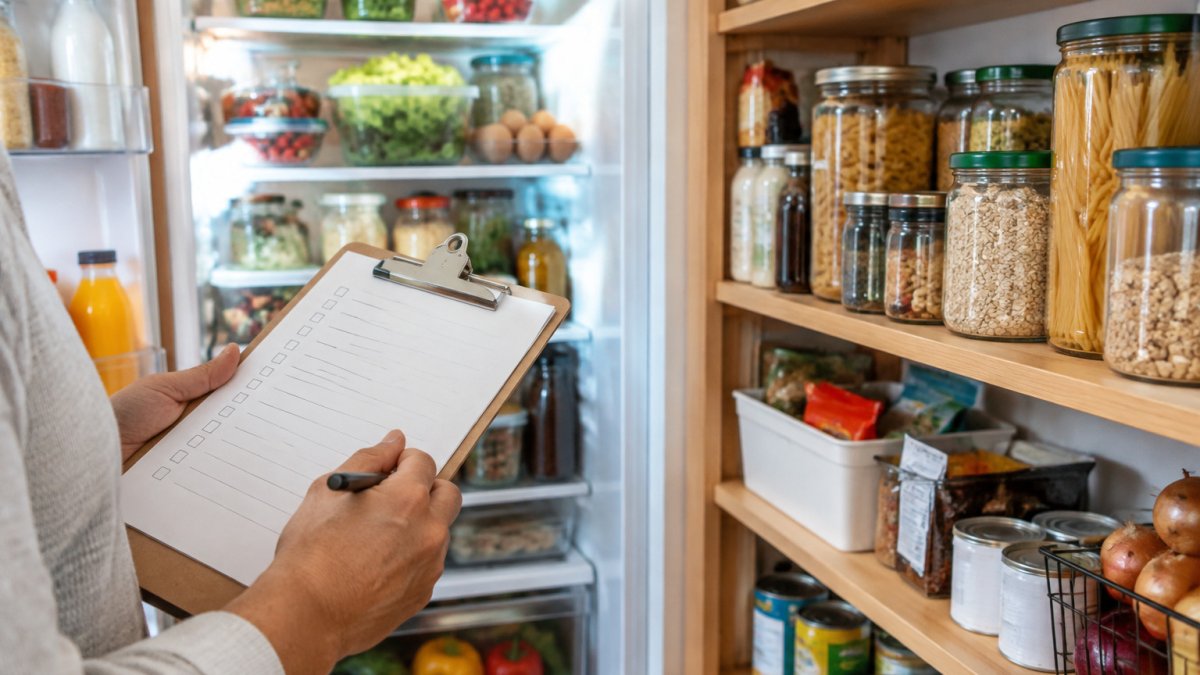
!Close-up of a parent's hands holding a clipboard beside an open refrigerator and a pantry shelf stocked with dinner ingredients in a bright home kitchen
Walk through three areas:
- Pantry: Grains, canned goods, sauces, seasoning mixes.
- Fridge: Produce, dairy, leftovers that need eating soon.
- Freezer: Proteins, frozen vegetables, prepared meals.
Write down what you have on a notepad or phone. Then build your dinners around those items first.
Step 4: Build a 7 Day Family Meal Plan Around Your Schedule
Now assign a dinner to each night. Match the fast meals to busy nights, and use leftovers on nights you are out.
Here is a simple way to fill the week:
- Monday (busy): A one-pan skillet meal that takes 30 minutes. The Tuscan Chicken Alfredo Skillet fits this slot well.
- Tuesday (medium): A familiar staple recipe you already know.
- Wednesday (late): Leftovers from Monday, or a freezer meal.
- Thursday (busy): A quick skillet dinner. The Weeknight Lasagna Skillet is built for this kind of night.
- Friday (relaxed): Pizza night or a new recipe you want to try.
- Saturday: Cook something slower, or plan a family favorite.
- Sunday: Prep ingredients for the week ahead.
If you want a step-by-step guide to batch-prep for busy nights, read How to Meal Prep for Busy Weeknights: A 7-Step Plan.


How to Meal Plan for the Week on a Budget
Budget planning starts with the menu, not the store. When you know your dinners, you buy only what those meals need, and you can set a spending target before you ever walk into the grocery store.
Start with a weekly grocery target. Most households already know roughly what they spend; if you do not, check your last two receipts and average them. Write that number at the top of your menu. Then build the week so the menu fits the number rather than discovering the total at checkout.
Three mechanisms do most of the work:
- Ingredient reuse across meals. Choose two or three meals that share a perishable ingredient, then use it fully. If Monday's skillet uses half a bunch of spinach, Thursday's pasta should use the other half. A whole rotisserie chicken can become Monday's dinner, Tuesday's sandwiches, and Wednesday's soup. This is the single biggest lever on both spend and waste.
- A sale-first anchor. Check the store's weekly ad or app before you finalize the menu. Build one or two dinners around what is discounted, then fill the rest with staples. You are not chasing every sale; you are anchoring the week on the protein or produce that is cheapest right now.
- One meatless dinner. A beans, lentils, or egg-based dinner once a week reliably lowers the total without feeling like a sacrifice, and it doubles as a flex night if plans change.
Then plan the perishables on purpose. Before you shop, look at what is already in the fridge and assign each item a night. Produce that spoils fastest, greens, berries, fresh herbs, mushrooms, goes on the earliest nights. Heartier items like carrots, cabbage, and potatoes can wait until later in the week. Anything you cannot fit into a meal gets frozen or cooked into a backup dish rather than left to wilt.
Watch out: Buying in bulk only saves money if the food gets eaten. A family-size package of chicken that half-spoils costs more per meal than the smaller package you would have finished. Match package size to the number of meals you have actually planned.
Keep a running grocery list built directly from the menu, organized by store section, produce, meat, dairy, pantry, so you shop once and in a straight line. A written list also cuts impulse buys, which are the quiet budget leak in most weekly shops. Check your cart total against your target before you reach the register, and if you are over, drop the item that is not tied to a planned meal.
Finally, track two numbers for a month: what you planned to spend and what you actually spent, plus how much food you threw away. Most households find the gap is smaller than they feared and the waste is larger, which tells you exactly where to adjust next week.
Meal Planning for Beginners: Templates and Printables
You do not need an app to plan well. A simple template works just as well.
Create a grid with seven rows, one for each day. Add three columns: dinner, ingredients needed, and who cooks. Keep the grid on your fridge or in a shared note.
Here is a quick template to copy:
| Day | Dinner | Ingredients Needed | Notes |
|---|---|---|---|
| Monday | Skillet meal | Chicken, pasta, cream | Busy night |
| Tuesday | Staple recipe | Rice, beans, vegetables | Familiar meal |
| Wednesday | Leftovers | None | Quick reheat |
| Thursday | Skillet meal | Ground beef, noodles | Busy night |
| Friday | New recipe | Varies | Try something new |
Reuse the template each week. Over time, you will build a list of favorite meals you can rotate.
Start Your First Weekly Dinner Menu This Sunday
Pick a set time this Sunday, about 30 minutes, and work through the steps in order. Count your dinners, check your calendar, take inventory, assign meals, and write your grocery list.
Once the system is in place, it takes less time each week. Shop Wacky makes it easy with skillet meal kits and seasoning blends that turn a planned night into a gourmet dinner in about 30 minutes.
Frequently Asked Questions
How do you meal plan dinner for the week?
Start by choosing how many dinners you need, then check your weekly schedule for busy nights and the ingredients already on hand. Pick a mix of familiar staple recipes and one or two new dishes, and plan leftovers so one cooking session covers two meals. Write the menu by day, then build your grocery list from it. Doing this on the same day each week keeps the routine quick, usually in under 30 minutes once it becomes habit.
How do you meal plan for the week on a budget?
Build the weekly menu around ingredients you already have in the pantry, refrigerator and freezer before you shop. Choose recipes that share ingredients so one purchase supports several dinners, and plan leftovers to reduce food waste. Shop from a grocery list that matches the menu so you avoid impulse buys. Shop Wacky's Weeknight Lasagna Skillet at $11.99 serves 6-8 and can anchor a budget-friendly weeknight dinner.
What does a 7 day family meal plan look like?
A practical 7 day family meal plan lists one dinner for each night, with the busiest evenings assigned quick meals under 30 minutes. Mix in one or two new recipes and keep familiar favorites on the rotation. Assign one night for leftovers and another for a flexible backup meal in case plans change. Writing the plan by day, rather than as a loose list of dishes, makes it easier to match each dinner to your schedule.
What is the best way for beginners to start meal planning?
Beginners should start small: plan four or five dinners rather than seven, and reuse staple recipes the family already likes. Use a simple printable template with columns for each day, the meal, and the ingredients needed. Review the plan each week and adjust based on what got eaten and what was wasted. Once the routine feels easy, add new recipes gradually and expand the plan to a full week.
